
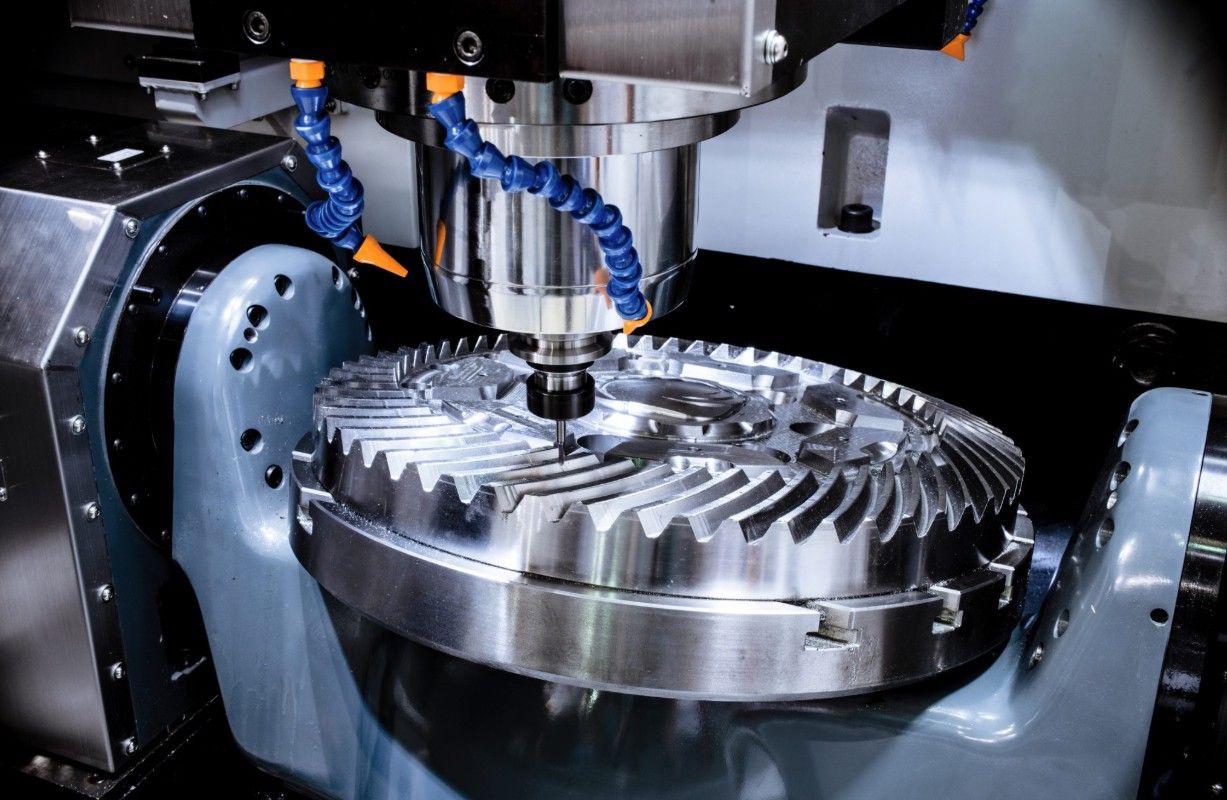
Choosing the right material and machining method for a custom part is one of the most consequential decisions in the design process, and it's one where many buyers feel less confident than they'd like. The options are broader than most product specifications require, and the interaction between material properties, machining behavior, and finishing compatibility adds a layer of complexity that isn't always obvious from a data sheet. Understanding what's commonly available through CNC machining in China and how different materials and methods interact with each other gives you a stronger foundation for making those decisions before you submit a drawing for quoting.
This guide covers the most widely used materials in CNC machining, the primary machining methods and when each is appropriate, and the finishing options that complete a precision machined part from raw stock to finished component.
What Materials Are Routinely Available for CNC Machining in China?
The material range available from capable Chinese CNC suppliers covers virtually everything a product engineer is likely to specify for a functional part. Aluminum alloys are the most common starting point, and for good reason. Aluminum machines quickly, produces clean cut surfaces, holds tight tolerances reliably, and responds well to anodizing and other finishing processes. It's the default choice for enclosures, brackets, housings, heat sinks, and structural components where weight and corrosion resistance matter alongside precision.
Within aluminum, grade selection matters more than buyers sometimes appreciate. 6061-T6 is the most versatile option, offering a good balance of strength, machinability, and finishing compatibility. It's the right choice for the majority of aluminum machined parts. 7075-T6 offers higher strength at the cost of somewhat reduced corrosion resistance and is used where structural loads are higher, as in aerospace and high-performance mechanical components. 5052 is softer and more formable, suited to sheet metal work rather than precision machining. Specifying the grade explicitly on your drawing prevents the supplier from defaulting to whatever is most convenient.
Steel covers a wide range within a single material category. Mild steel like 1018 and 1045 is affordable and machines well suited to structural and non-precision applications. 4140 alloy steel offers higher strength and is commonly used for shafts, gears, and load-bearing components. Stainless steel in grades 303, 304, and 316 provides corrosion resistance at the cost of higher machining difficulty and longer cycle times. 303 is the most machinable stainless grade due to its sulfur content. 316 offers superior corrosion resistance for marine and chemical environments but machines are slow and cost more than 303 or 304.
What Other Metals Are Commonly Machined?
Brass is one of the most pleasant materials to machine. It cuts cleanly, produces excellent surface finish from the tool, and is widely used for fittings, connectors, valve bodies, electrical components, and decorative parts where the warm gold color is part of the design intent. Common grades include 360 free-machining brass, which is specifically formulated for fast, clean cutting, and 260 cartridge brass, which is softer and used where forming characteristics matter alongside machinability.
Copper is used where electrical conductivity or thermal conductivity is the primary functional requirement. It machines acceptably but is softer than brass and requires sharper tooling and careful cutting parameters to avoid built-up edge on the tool, which degrades surface finish. Copper bus bars, heat spreaders, and custom electrical contacts are typical applications.
Titanium is available from suppliers with the appropriate equipment and experience, and it's worth understanding what makes it different before specifying it. Titanium has a low thermal conductivity, which means heat generated during cutting stays concentrated at the tool-workpiece interface rather than dispersing through the chip. This makes tool management critical and keeps cutting speeds lower than for steel or aluminum, which directly adds to machining cost. For applications where titanium's strength-to-weight ratio or biocompatibility is essential, such as in medical implants or aerospace structures, the cost premium is justified. For applications where another material could serve the function equally well, it's worth the conversation.
Which Engineering Plastics Can Be CNC Machined?
Engineering plastics form a substantial share of the CNC machining material range, and their availability from capable Chinese suppliers is broader than many buyers assume. Acetal, also sold under the trade name Delrin, is the most common engineering plastic for machined parts. It machines cleanly, holds tight tolerances, has low moisture absorption, and offers good wear resistance. It's used extensively for gears, bushings, wear pads, housings, and any application requiring a dimensionally stable plastic component.
Nylon machines well and offers good toughness and wear resistance, though its tendency to absorb moisture means it changes dimensions slightly in humid environments. This makes it less suitable for high-precision applications but appropriate for general mechanical components, cable guides, and wear surfaces where the moisture sensitivity isn't a problem. Glass-filled nylon grades improve stiffness and reduce moisture sensitivity at the cost of increased abrasiveness on cutting tools.
PEEK is the high-performance option for applications requiring resistance to elevated temperatures, aggressive chemicals, or regulatory compliance in medical and food contact applications. It machines well on properly equipped machines and holds tolerances reliably, but it costs significantly more than acetal or nylon. Polycarbonate is used where optical clarity or high impact resistance is needed alongside machinability. ABS, UHMW polyethylene, and PTFE round out the common range for more specialized applications.
What Are the Primary CNC Machining Methods?
CNC milling is the most widely used machining process. A rotating cutting tool moves across a stationary workpiece, removing material to create flat surfaces, slots, pockets, holes, and complex 3D profiles. 3-axis milling controls the tool in three linear directions and handles the majority of common machined part geometries. Most brackets, plates, housings, and structural components with features on one or two faces fall within 3-axis milling capability.
CNC turning rotates the workpiece while a stationary cutting tool removes material, producing cylindrical geometry. Shafts, bushings, spacers, threaded fasteners, valve bodies, and fittings are turned rather than milled. Turning produces rotationally symmetric features with high efficiency and excellent surface finish. Combination turning and milling machines, often called mill-turn centres, produce parts that require both cylindrical features and milled slots or flat faces in a single setup, reducing repositioning errors and improving geometric accuracy.
Drilling and tapping are frequently integrated into milling and turning operations rather than being separate standalone processes. CNC machining centres use rigid tapping cycles that produce accurate threads faster and with better positional control than hand tapping. Thread milling is used for large diameter threads, difficult materials, or applications where thread quality is particularly critical.
When Is 5-Axis Machining the Right Choice?
5-axis machining adds two rotational axes to the three linear axes of standard milling, allowing the cutting tool to approach the workpiece from virtually any angle without repositioning. The practical benefit is that complex parts with features on multiple faces, compound angles, or complex curved surfaces can be machined in a single setup rather than requiring multiple separate operations.
Every time a part is unclamped and repositioned on a 3-axis machine, the potential for small positioning errors is reintroduced. Those errors accumulate across multiple setups, and for parts with tight tolerance relationships between features on different faces, that accumulation can push dimensions outside tolerance. 5-axis machining eliminates most of those repositioning steps, producing better geometric accuracy on complex parts than sequential 3-axis operations can reliably achieve.
China Precision CNC's machining services include 5-axis capability for parts that require it. The decision of whether a specific part needs 5-axis machining is worth discussing during the quoting and DFM review stage. Some parts that appear to require 5-axis machining can be produced equally well on a 3-axis machine with a carefully designed fixture sequence. Others genuinely require the simultaneous multi-axis capability that only a 5-axis machine provides. An experienced supplier gives you that assessment honestly rather than defaulting to the more expensive process when it isn't needed.
How Does Material Choice Affect Machining Method Selection?
Material and method interact in ways that affect both the cost and the quality of the finished part. Aluminum is fast to machine in both milling and turning, which is part of why it's cost-efficient at low volumes. Steel takes longer and wears tools more quickly. Stainless steel takes longer still and is more sensitive to cutting parameter selection. These differences in cycle time flow directly into pricing, which is why an identical geometry in stainless steel costs more to produce than the same geometry in aluminum 6061.
Material hardness interacts with achievable surface finish. Harder materials can often achieve better surface finish directly from the cutting tool because the material resists deformation during cutting more effectively. Softer materials like aluminum and brass sometimes show tool marks more visibly and benefit from a finishing pass with a sharp tool and light cut to achieve a clean appearance. For parts where surface finish appearance matters as much as dimensional accuracy, discussing achievable finish quality for your specific material during quoting is worthwhile.
Plastic materials require different cutting parameters than metals. Lower cutting speeds, sharper tooling, and careful heat management prevent melting or smearing at the cutting interface, which degrades both surface quality and dimensional accuracy. Porous or fibrous materials like PTFE and glass-filled composites require tooling specifically suited to their cutting behavior. A supplier experienced with plastic machining manages these details as a matter of course. A supplier primarily set up for metal work may produce acceptable plastic parts or may not, and it's worth asking specifically about their plastic machining experience if your project includes plastic components.
What Surface Finishing Options Are Available After Machining?
Anodizing is the standard finishing process for aluminum and the most commonly specified option. Type II anodizing produces a hard aluminum oxide layer that improves corrosion resistance and provides a surface that can be dyed in a range of colors. The anodized layer is integral to the aluminum surface rather than being a coating applied on top, so it doesn't peel or flake and adds minimal dimensional change to machined surfaces. For parts with tight tolerance features, the dimensional impact of anodizing is measured in microns and is predictable enough to account for in the machining dimension.
Type III hard anodizing produces a thicker, harder coating with better wear resistance than standard Type II. It's used for parts that face surface contact, abrasion, or wear in service. The harder coating adds more dimension than Type II and requires more careful pre-anodize machining allowance to achieve the correct finished size on tight tolerance features. Clear hard anodizing has a slightly darker appearance than standard anodizing due to the coating thickness.
Bead blasting before anodizing creates a uniform matte texture that removes tool marks and any surface irregularities from machining, giving the part a clean, consistent appearance under the anodize. The combination of bead blast plus anodize is the most common finishing specification for precision aluminum parts where appearance alongside function matters.
What Finishing Options Apply to Steel and Other Metals?
Steel and stainless steel don't respond to anodizing, which is specific to aluminum. The common finishing options for steel depend on the application requirements. Powder coating provides durable color coverage with good corrosion resistance and is available in a wide range of colors. It's used for structural steel parts, enclosures, and components where appearance and basic protection are both required.
Electroless nickel plating deposits a uniform nickel layer over steel, aluminum, or other substrates, providing hard, corrosion-resistant surface protection with good dimensional uniformity. Unlike electroplating processes, electroless nickel deposits at a consistent thickness across the entire surface regardless of geometry, which makes it suitable for precision parts where coating thickness uniformity matters.
Black oxide is a chemical conversion coating for steel that provides mild corrosion resistance and a dark, non-reflective appearance. It's commonly used for tooling components, mechanical parts, and applications where a low-profile dark finish is preferred over a heavier coating. Zinc plating provides basic corrosion protection for steel hardware components at low cost. For stainless steel, passivation removes free iron from the surface and restores the passive chromium oxide layer that gives stainless its corrosion resistance, and it's recommended for stainless parts used in corrosive environments or medical applications.
How Do You Specify Materials and Methods Correctly on a Drawing?
Material specification on a drawing should be unambiguous. "Aluminum 6061-T6 per AMS 2770" is a complete specification. "Aluminum" is not. The difference matters because a generic material callout invites substitution with whatever grade the supplier has in stock, and different grades have different mechanical properties, machinability characteristics, and finishing behavior.
Specifying machining method on a drawing is usually unnecessary and often counterproductive. Machining method is the supplier's domain, and they're best placed to determine the most efficient approach to produce the geometry you've specified to the tolerances you've called out. Where method does need to be specified is when it affects part properties in ways the drawing can't communicate otherwise. Requiring a specific surface texture direction, specifying that no heat input from welding or EDM is acceptable, or requiring that a specific feature be produced in a single setup for geometric accuracy reasons are examples where a process note is justified.
Surface finish specification should use measurable parameters rather than descriptive terms. Ra 0.8 µm is a measurable specification. "Smooth finish" is not. For anodizing, specifying the type, color, and thickness range gives the supplier and the finishing house a clear target. For plating, specifying the process, thickness range, and any relevant standards ensures the coating meets functional requirements rather than just looking right on visual inspection.
How Does China Precision CNC Handle Material and Method Selection?
China Precision CNC provides custom manufacturing services including CNC machining across the material range that precision product development and production work requires, from standard aluminum alloys and engineering steels through plastics and specialty metals. Their team reviews incoming projects for DFM considerations before production begins, which includes flagging material and method choices that could affect manufacturability, quality, or cost.
For buyers at the design stage who haven't finalized material selection, that review process provides useful input about how different material choices affect pricing and production complexity. For buyers with fixed material specifications, it confirms that the specified material is available and appropriate for the machining approach the design requires. Either way, the conversation happens before production rather than during or after, which keeps the project on track.
Their Los Angeles office at 1055 West 7th Street, Suite 3300 provides a US-based point of contact for buyers who want to have those material and method conversations in real time, during US business hours, with a team that can translate between engineering requirements and production practicality on both sides of the relationship.
Ready to Get Started?
Material and method selection is foundational to getting the right outcome from CNC machining in China. Buyers who specify materials clearly, understand how their choices affect cost and lead time, and work with suppliers who provide honest DFM input before production begins consistently get better results than those who leave those decisions to chance or interpretation.
To discuss your material requirements or get a quote for your next precision parts project, contact Hafiz Pan, Director of Operations at China Precision CNC, at +1 361 301 9442 or [email protected]. Their team provides CNC machining, sheet metal fabrication, rapid prototyping, and low-volume production with fast turnaround times and reliable production support for businesses ready to move from design to finished precision parts.