
Lumbar spine pain is not a single condition with a single solution. Two people presenting with pain in the same spinal region can have entirely different underlying mechanisms, completely different movement patterns, and respond to opposite exercise approaches. This is why generic back pain programs produce inconsistent results, and why personalised exercise planning makes such a meaningful difference to outcomes.
The path to lumbar spine pain recovery through individualised exercise is grounded in clinical assessment, not assumption. Understanding what is driving the pain, what has maintained it, and what the individual needs to return to in their daily life shapes every decision in a well-designed program.
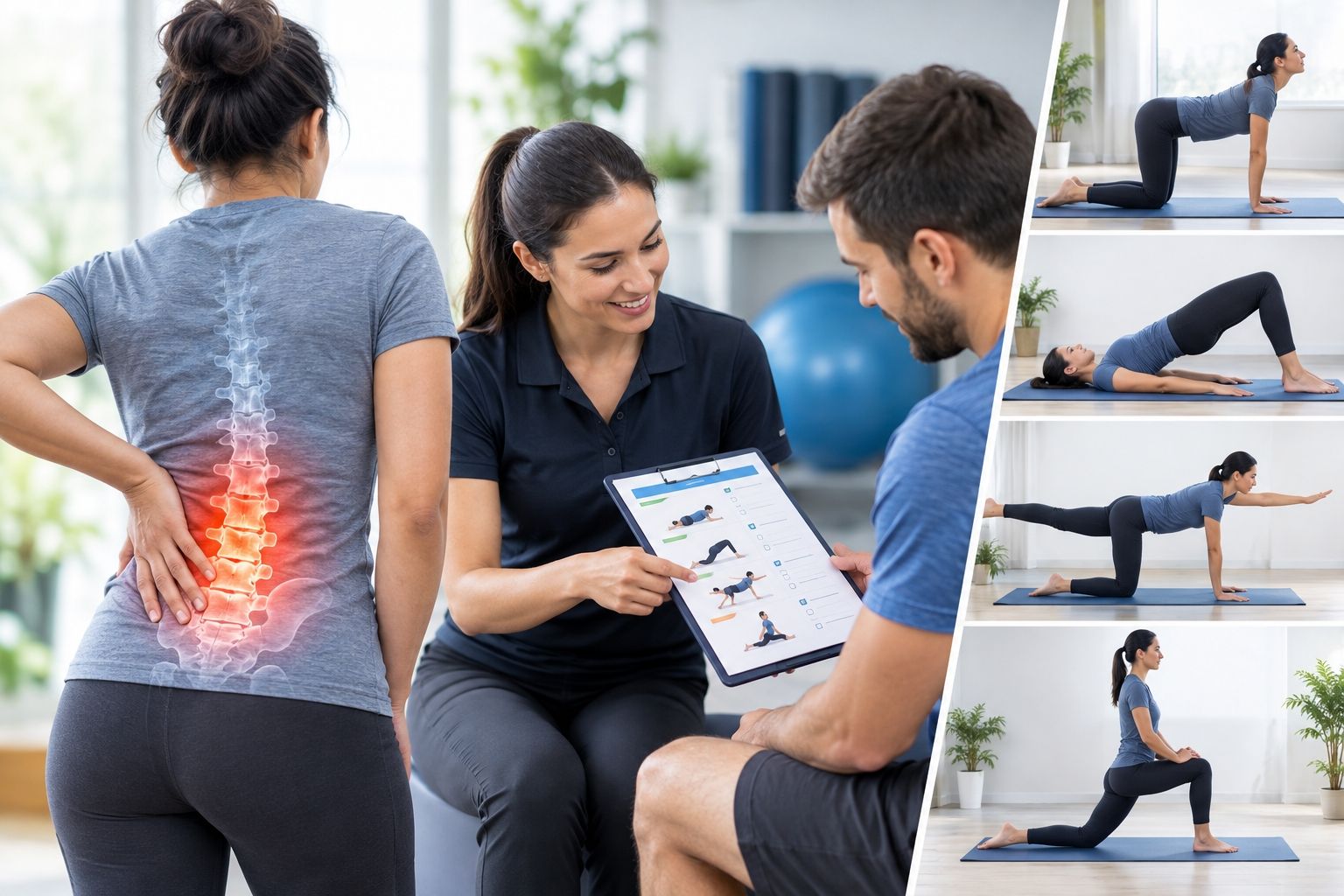
Understanding Lumbar Spine Pain
The lumbar spine comprises five vertebrae sitting between the thoracic spine and the sacrum. This region carries significant compressive load, manages force transfer between the upper and lower body, and allows the range of movement that bending, lifting, and rotating in daily life requires.
The structures that can contribute to pain in this region include:
- Intervertebral discs: Bulging, herniated, or degenerated discs can compress adjacent nerve roots or directly irritate pain-sensitive structures
- Facet joints: Small joints at the back of each vertebral level that guide movement and bear load, particularly during extension and rotation
- Muscles and fascia: The erector spinae, multifidus, quadratus lumborum, and surrounding musculature can develop pain-generating trigger points or suffer strains
- Nerve roots: Compression or irritation of lumbar nerve roots produces both local pain and referred symptoms into the buttock and leg
- Ligaments: Overstretched or damaged spinal ligaments produce pain and can contribute to segmental instability
For many people with persistent lumbar pain, no single structure is clearly responsible. The pain has become self-perpetuating through central sensitisation, where the nervous system has learned to produce pain in response to stimuli that would not normally be threatening.
Why Personalisation Matters More Than Most People Realise
The same exercise that helps one lumbar pain patient significantly aggravates another. Extension exercises that centralise symptoms for someone with a posterior disc herniation can worsen facet joint pain in someone whose primary driver is different. Core stability exercises that reduce pain for one person may be irrelevant for someone whose primary limitation is hip muscle weakness and poor load transfer.
These differences are not minor variations. They determine whether an exercise program helps, does nothing, or makes things worse. Getting the assessment right before prescribing anything is what makes personalised programs consistently more effective than standardised approaches.
Research supports this consistently. A review published in resources by the Cochrane Collaboration found that exercise therapies for chronic low back pain are more effective when individually designed and supervised than when delivered as standardised group programs, with individualised approaches producing greater improvements in pain and function.
This does not mean that standardised elements have no role. Many aspects of lumbar pain rehabilitation are broadly applicable. But the sequencing, emphasis, and specific exercise selection should reflect the individual's presentation rather than a template.
The Clinical Assessment Behind Personalised Programs
A personalised exercise plan for lumbar spine pain begins with a thorough clinical assessment. This assessment is where the information needed to make good exercise prescription decisions is gathered.
Movement Assessment
How the lumbar spine moves tells the clinician a great deal about which structures are involved and which directions are safe to load.
Key movement evaluations include:
- Flexion: Can the patient bend forward? Does this increase or decrease symptoms? Do symptoms peripheralise into the leg or centralise toward the spine?
- Extension: Does backward bending produce pain? Where? Does it centralise or peripheralise referred symptoms?
- Lateral flexion: Is movement equal to both sides? Does bending to one side reproduce the patient's familiar pain?
- Rotation: How much rotation is available, and does rotation reproduce symptoms?
The pattern of movement response guides initial exercise direction selection and helps identify which movements need to be avoided or modified in early stages.
Neurological Screening
When lumbar pain is accompanied by leg symptoms, neurological screening identifies whether nerve root involvement is present and at which level. Reflexes, dermatomal sensation, and myotomal strength are assessed systematically. Significant neurological deficits may alter the exercise approach or indicate the need for medical review before commencing a loading program.
Functional Capacity Assessment
Standardised functional tests provide objective baseline measures against which progress is tracked. Common assessments for lumbar pain include:
- Sit-to-stand test: Measures lower limb strength and functional mobility
- Timed up and go: Assesses overall functional mobility
- Six-minute walk test: Provides cardiovascular and functional endurance baseline
- Prone extension test: Assesses lumbar extensor endurance
- Biering-Sorensen test: Measures posterior chain endurance capacity
These baselines serve two purposes. They inform program design and provide the objective data that demonstrates change over the treatment period, which is valuable both for patient motivation and for reporting to GPs and insurers.
Psychosocial Assessment
Fear-avoidance beliefs, pain catastrophising, depression, and anxiety all independently affect lumbar pain outcomes and should be identified during assessment so they can be addressed within the program. Validated screening tools including the Fear-Avoidance Beliefs Questionnaire and Patient Health Questionnaire are commonly used for this purpose.
Identifying high fear-avoidance early allows the exercise physiologist to incorporate more graded exposure and education into the program from the outset, reducing the avoidance behaviours that maintain disability.
Building the Personalised Program
Foundation Phase: Establishing Safe Movement
The first phase of a personalised lumbar pain program establishes what movements and loads the patient can engage with consistently without significant exacerbation. This is not about finding the minimum that avoids all pain. It is about finding the appropriate starting point for progressive loading.
For some patients, particularly those with acute or severe presentations, the foundation phase is brief and gentle:
- Short walking sessions building gradually in duration
- Gentle neural mobilisation if nerve involvement is present
- Education about pain and the rationale for active management
- Position and posture strategies that reduce load in the short term
For others with more stable presentations and better baseline capacity, the foundation phase may include light resistance exercises from the outset.
Strength Building Phase: Progressive Loading
As the foundation phase establishes consistent activity tolerance, the program progressively introduces and increases resistance exercise targeting the muscles that support lumbar function.
Posterior chain development is central to most lumbar pain programs. The glutes, hamstrings, and lumbar erectors are the primary load managers during lifting, carrying, and dynamic activities. Weakness in these structures forces compensatory loading of passive spinal structures including discs and ligaments.
Hip hinge progressions build this capacity systematically:
- Bodyweight hip hinge pattern establishment
- Band-resisted hip hinge
- Kettlebell or dumbbell Romanian deadlift
- Barbell hinge variations as capacity develops
Anterior core capacity builds the ability to resist unwanted lumbar flexion under load:
- Dead bug variations with progressive limb loading
- Pallof press with resistance band
- Anti-extension planks progressing from knees to toes
- Loaded carries that challenge core bracing under compressive load
Hip and glute isolation addresses specific weaknesses that alter load distribution through the lumbar spine:
- Glute bridges progressing to single-leg variations
- Clamshells and lateral band walks for hip abductor strength
- Single-leg exercises that develop balance and unilateral hip capacity
Functional Integration Phase
The final phase of a well-designed lumbar program bridges the gap between clinical exercises and the demands of real life. This means identifying what the patient needs to be able to do and specifically training those capacities.
A tradesperson needs the capacity to lift heavy materials repeatedly throughout a workday. Their program includes loaded carries, squat and hinge patterns with increasing weight, and fatigue-management strategies for sustained physical work. A desk worker needs the capacity to maintain good movement patterns after prolonged sitting and to manage the transition between sustained postures and active movement. An active parent needs the capacity to lift, carry, and move with children at unpredictable angles and loads.
Functional integration makes the exercise program meaningful rather than merely rehabilitative. It connects the clinical work to the patient's actual life and provides the motivation that sustains engagement through the full program.
Education as a Treatment Component
Lumbar pain rehabilitation that does not include substantive patient education is incomplete. The understanding patients have of their pain directly affects their behaviour, their fear-avoidance, and their engagement with active rehabilitation.
Key education content for lumbar pain programs:
The biology of chronic pain: How central sensitisation develops and why pain persists beyond tissue healing. This knowledge reduces catastrophising and increases willingness to engage with movement.
The adaptive capacity of spinal tissues: Understanding that the spine is a robust structure designed for load, not a fragile structure requiring protection, shifts patients from avoidance to engagement.
The evidence on rest versus activity: Knowing that clinical guidelines consistently recommend activity over rest for lumbar pain gives patients confidence that movement is appropriate even when it is uncomfortable.
Flare-up management: Understanding that pain flares are common, expected, and do not represent tissue damage prevents the catastrophic interpretation of normal recovery fluctuations that leads people to abandon programs prematurely.
According to Musculoskeletal Australia, patient education about the nature of musculoskeletal pain is associated with improved outcomes and reduced healthcare utilisation for people with chronic back conditions.
Adapting Programs for Specific Lumbar Diagnoses
Lumbar Disc Herniation
Programs for disc herniation typically emphasise directional preference assessment first, since most herniations respond to extension-biased movement that reduces posterior disc pressure. Neural mobilisation addresses nerve root adherence. Progressive posterior chain loading builds the muscular support that reduces mechanical load on the affected disc level.
Flexion loading is generally introduced cautiously and progressively once directional preference work has centralised symptoms, building tolerance to the flexion demands of daily activities without provoking unnecessary disc loading in early stages.
Lumbar Spinal Stenosis
Stenosis programs are typically flexion-biased in early stages because spinal canal space increases with flexion. Walking with a slightly forward-leaning posture, stationary cycling, and aquatic exercise are often well-tolerated starting points. Extension loading is introduced gradually as overall capacity builds and symptoms stabilise.
The cardiovascular deconditioning common in older adults with stenosis often requires specific attention, since general fitness significantly affects functional capacity and pain tolerance.
Spondylolisthesis
Programs for spondylolisthesis require particular care around exercises that increase shear force at the unstable level. Extension and rotation loading at the affected segment are modified or avoided initially, with emphasis placed on building the muscular stability that reduces abnormal segmental movement.
Progression is often more conservative than for other lumbar diagnoses, with close attention to symptom response at each loading increment.
Non-Specific Lumbar Pain
Non-specific lumbar pain, where no identifiable structural cause accounts for the symptoms, represents the majority of lumbar pain presentations. Programs are guided by movement assessment findings, functional capacity baseline, and psychosocial factors rather than by a structural diagnosis.
The absence of a clear structural cause is often experienced as frustrating by patients who want an explanation. Education about pain science is particularly important for this group, since understanding that pain does not require tissue damage to be real and significant reduces the anxiety that drives fear-avoidance.
Monitoring Progress Objectively
Personalised programs require personalised outcome measurement. Progress is tracked through the functional assessments established at baseline, through patient-reported outcome measures, and through direct observation of exercise performance.
Common outcome measures for lumbar pain rehabilitation include:
Regular reassessment, typically every four to six weeks, determines whether the program is producing the expected response and identifies when progression is appropriate or when the approach needs adjustment.
FAQs
How is a personalised program different from a standard back pain program?
It is designed around your specific movement assessment findings, functional limitations, diagnosis, and goals rather than applied uniformly to everyone with back pain.
How long before a personalised exercise program produces results for lumbar pain?
Most people notice meaningful functional improvement within six to ten weeks. Pain reduction often follows functional improvement with some delay.
Does a personalised program cost more than a standard approach?
The initial assessment is more thorough, but the improved outcomes typically mean fewer total sessions are needed than with a standardised approach that requires repeated modification.
Can I do a personalised program at home?
The home component is essential. A good personalised program includes supervised sessions and a home exercise component that builds capacity between appointments.
How often should a personalised program be reviewed and updated?
Every four to six weeks is typical for formal review. The exercise physiologist adjusts the program based on progress data and current capacity at each review.
Recovery That Is Built Around You
Lumbar spine pain recovery is not a straight line, and it is not the same journey for any two people. What it shares across presentations is a dependence on progressive, appropriately loaded exercise that is designed around the individual rather than applied generically.
The clinical assessment, program design, and ongoing progression management that personalised exercise physiology provides is what makes the difference between programs that produce lasting change and those that produce temporary symptom relief before the same pain returns.
For Melbourne patients dealing with lumbar pain that has resisted generic treatment approaches, working with an accredited exercise physiologist who takes the time to understand the specific presentation and build a program around it represents the most evidence-aligned pathway to meaningful, durable recovery.